Real-time shopping cart architecture in Power Pages beyond caching limits
How to combine performance and dynamic data synchronization in Power Pages. An architectural analysis of bypassing server-side caching with the Power Pages Web API.
Contents
- The caching problem in Power Pages
- The solution architecture with asynchronous Web API calls
- Visual feedback and real-time synchronization
- The platform for data and the API for dynamic behavior
The caching problem in Power Pages
Microsoft Power Pages uses extremely aggressive server-side caching to ensure globally scalable loading times and high portal performance. What is a major technical advantage for static information pages becomes an architectural constraint for highly dynamic transactions such as an e-commerce shopping cart. In our Power Pages design series, we have already explained why standard files always load and how they affect loading performance.
A typical scenario: a user adds a product to the cart, but the platform’s standard lists do not reflect the change. The changed state only becomes visible on the client after a full page reload that invalidates the cache. This behavior is unacceptable in modern web applications because it seriously harms the user experience and causes confusion.
For our e-commerce showcase project, the requirement was therefore clear: the transition from an anonymous user to an authenticated session must be seamless, and every cart interaction must appear on screen in real time without reloading the page. A well-structured design system provides the foundation for visually supporting these dynamic updates.
The solution architecture with asynchronous Web API calls
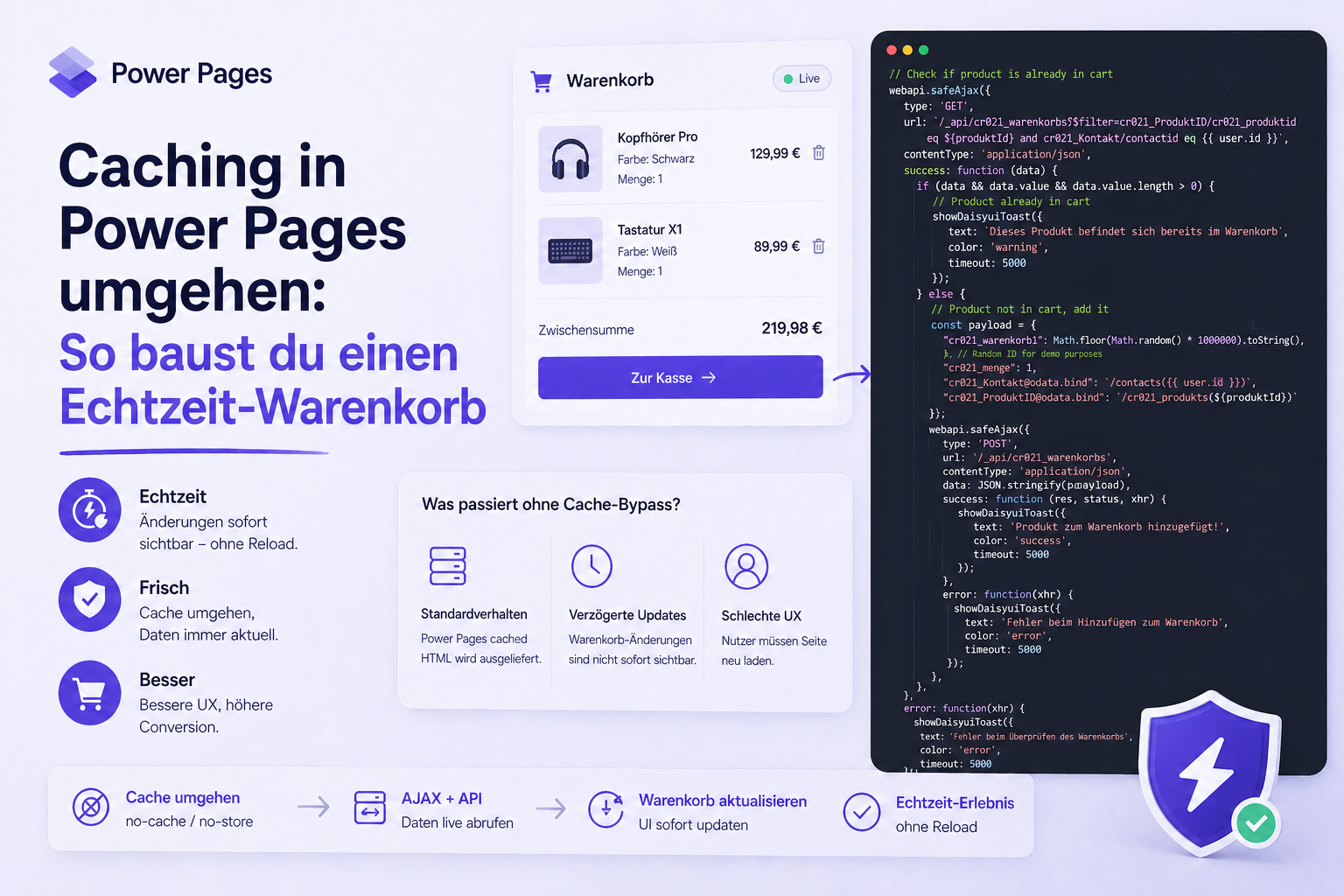
To decouple the application from the platform’s server-side caching, we moved away entirely from standard server-rendered lists (Entity Lists). Instead, the architecture uses a decoupled asynchronous pattern with the Power Pages Web API and modern JavaScript. The project documentation on cart validation provides the details.
Before any database write, the process performs multi-stage client-to-server validation in the background:
- Identity check: Is the calling user authenticated, or is the session anonymous?
- Availability validation: Is the product still in stock, and has the individual order limit not yet been reached?
- Duplicate detection: Does this item already exist in the current cart?
Visual feedback and real-time synchronization
The major architectural advantage of this decoupling is fewer redundant database calls. If the Web API identifies a duplicate, for example, the payload is not sent to the Dataverse backend. Instead, the asynchronous logic triggers immediate visual feedback in the frontend.
A modern toast notification immediately appears at the edge of the screen, such as the message “Product already exists in the cart”. This minimizes server load and brings UX design to enterprise standards. Anonymous users are handled just as efficiently: instead of a server-side redirect to the login page, a clear prompt asks them to authenticate for checkout. The article on CSS isolation and the three-layer strategy explains how we technically isolated these interfaces.
The platform for data and the API for dynamic behavior
Building highly dynamic, real-time features on low-code platforms requires moving beyond server rendering. Aggressive caching cannot be ignored, but suitable architectural patterns can bypass it.
In this hybrid structure, Power Pages and Microsoft Dataverse serve exclusively as a stable, highly secure backend for data management. Lightweight asynchronous Web API requests control the frontend and dynamic user interface. Although Microsoft offers native payments integration through multistep forms, this standard approach quickly reaches its limits in complex enterprise processes.
In our showcase, we therefore deliberately moved beyond the out-of-the-box limitations and implemented a fully decoupled checkout with Power Automate. This small amount of additional development work pays off significantly: the portal performs well and feels like a native, modern application that leads seamlessly into a secure checkout process without compromising backend scalability.